Friday, April 10, 2009

April 10

This post will cover Pitcairn Island and French Polynesia. First, here’s an glimpse of the view from my balcony while sailing in the South Pacific.


Pitcairn Island - We did not go ashore at Pitcairn Island - instead, around 40 of the roughly 70 inhabitants came aboard ship to sell their wares and tell us about their island. Pitcairn Island is the island that Fletcher Christian ended up on after disembarking Captain Bligh & some of Bligh’s supporters from the Bounty. The inhabitants of Pitcairn Island are primarily descendents of Fletcher Christian and other sailors from The Bounty. Betty Christian gave a very informative presentation about their island. She is well traveled and well spoken. Prior to arriving at Pitcairn Island, we were able to watch The Bounty starring Mel Gibson & Anthony Hopkins which is relatively factual according to our lecturer.


Natives arriving in their longboat.


Pitcairn Natives selling souvenirs on our Pool Deck.


Pitcairn Island - Shed at lower left is where long boat is stored.
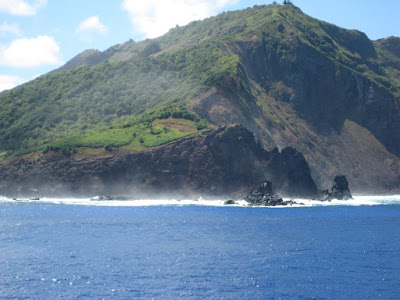


Another shot of Pitcairn Island.


Papeete, Tahiti - Went on a tour where we saw a beautiful waterfall, gardens and Marae Arahurahu. A marae is an ancient temple or meeting place where pre-colonial islanders worshipped their Moahi gods. On the way to the marae, the tour guide explained that every November, a male was sacrificed to the gods at this site (didn’t catch whether she said they volunteered or where chosen). Before we arrived, she encouraged us to be respectful of this sacred site, so everyone was quiet - you could only hear the birds chirping. The site felt very peaceful and everyone seemed to be touched by the experience.
In the evening a group of Tahitian performers came on board our ship and put on a lovely show (no pictures).


Cruising into Papeete, Tahiti


View of Matavi Bay & Moorea from Tahara's Viewpoint


Arahoho Blowhole - a few unlucky fellow tourists got drenched
by a huge wave that came up over the railing.


Me & Vaimahutu Waterfall


Marae of Arahurahu - Markers listing ancestors of human sacrifice.


Marae of Arahurahu


More Markers


Where Ceremony was Organized


Moorea - Moorea was beautiful - probably my favorite of the islands. The tour I took was a tour with a photographer. He gave us some useful tips and hopefully you will see the benefits as my picture taking evolves.


Arriving in Moorea


View from Magic Mountain


Another view from Magic Mountain.


Mt. Rotui
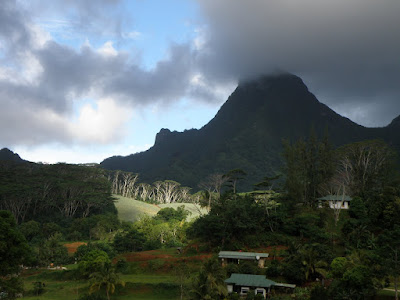


Couldn't see the mountain top, but the sun through the clouds was interesting.


Welcoming Committee at Moorea


Bora Bora - It appears that Bora Bora has become a little congested. I think a vacation at a resort on one of the motu’s (islet) with the grass covered huts would be quite enjoyable. Less congestion and closer to water sports. They say this island was the inspiration for the island Bali Hai in South Pacific. We did have a bloody mary at Bloody Mary’s!


Arriving in Bora Bora - not enough sun to see the different colors of blue in the water.


Resort at one of the Motu's (islets)


Fa'anui Bay


Matira Beach


Ruth, a Local, Gigi & I at Bloody Mary's


Due to rough seas, we were not able to stop at Rarotonga, Cook Island. Next, New Zealand & Australia…..

Wednesday, March 11, 2009

March 11, 2009

Happy Birthday, Rosemary!


Here's Robinson Crusoe Island and Easter Island.


On March 2 the seas were too rough for us to tender to Robinson Crusoe Island (formerly known as Mas a Tierra). This is the largest island of the Chilean Juan Fernandez archipelago. However, not to worry, the natives came to our ship and we really had a great time listening to their music and dancing with the “pirates”. We heard an excellent lecture the day before with the more factual version of Alexander Selkirk’s four years on this island before being rescued by Captain Woods Rogers. It seems Daniel Defoe embellished a bit on the story. Here are some pictures of our party - I was the very happy recipient of a pirate’s hat from the singer in the band - Laura would have been proud of me!


Robinson Crusoe Island


The Local Band


The Leader of the Band and my new hat.


My Dance Partner


My friend, Ruth, and her new friends.


Some Island Facts


Easter Island - March 6

We were crossing our fingers that we would have better luck weather-wise at Easter Island than we had at Robinson Crusoe Island. We were so happy to have a beautiful sunny day and seas that were not too rough for the tenders.

The most isolated island in the world, Easter Island was named by Dutch explorer Jacob Roggeveen when he landed here on Easter Sunday in 1722. The explorer found a thriving native population that lived in tight-knit communities of hare paengas, or boat-shaped houses. To communicate they had created rongorongo, a beautiful script and the only written language in all of Polynesia. But their greatest achievement was the hundreds of sad-eyed stone statues called moais they erected to honor their ancestors. By the time British Captain James Cook anchored here, just 50 years later, he found only several hundred people and many of the moais toppled from their foundations. During the ensuing century, raids by slave traders, disease, and colonial disenfranchisement further decimated the local population. So many people died that to this day, no one has been able to decipher the language. Today Easter Island’s primary industry is tourism, and the residents, most of whom are descended from the original inhabitants, are extremely proud of their island’s past.

Couple of other bits of information - the people of Easter Island called themselves the Rapa Nui and the word “Ahu” describes the platform upon which the moais are erected.


Easter Island


Quarry from which Moai were carved (volcanic rock)


One of hundreds of Moai in this quarry that weren't completed and moved to an Ahu.


A carving still in the rock (face laying down)


Carved Moai still in stone (El Gigante - 72 feet)


Ahu Tongariki - 15 Moais stand side by side on a 200 foot-long ahu.
This was restored after having been destroyed by a tidal wave in 1960.


Ahu Tongariki without tourists!


Me & Moais - One behind me is 92 tons. - hope I don't catch up!


Lunch at Anakena Beach


Anakena Beach


Ahu Ko Te Reku

The eyes have been put in this Moai which is the point at which it was believed that the spirit of the ancestor being represented by the Moai enters the Moai. The Moai face inland so that the spirit of the ancestor protects the inhabitants of the island. Our ship is to the left of the Moai.

Later............

Monday, March 9, 2009

March 8, 2009

I'm going to catch up today. This post will cover Puerto Montt and Valparaiso, Chile.


We had a lovely tour on February 26 visiting the Petrohue Falls, Puerto Varas & getting spectacular views of the Osomo Volcano. This area, just north of Puerto Montt is called the Lake District. There is a strong German influence in this area, so while visiting Puerto Varas, we were compelled to have a coffee and German pastry. The day we visited was beautiful - sunny and warm. Our tour guide told us we were very lucky since this area experiences around 252 days of rain per year. I have a million pictures of the volcano, but will not post them all!!


Petrohue Falls (North of Puerto Montt)


Osomo Volcano


Petrohue Falls


On February 28 we visited Valparaiso. This was once a very busy port and has a strong European influence. Valparaiso was a trading base in the Southern Pacific for the U.S and Europe, an international banking center as well as a key port for US shipping between the East Coast and California and European ships that rounded Cape Horn. It’s decline was the result of the development of steam ships which stopped at the coal mines around Concepcion instead, the opening of the trans-continental railway in the US, and then the opening of the Panama Canal in 1914. It declined further due to the development of a container port in San Antonio, the shift of banking to Santiago and the move of the middle class to nearby Vina del Mar, but Valparaiso is now reviving. Some of the beautiful buildings have been taken over by the Navy and the University. You will see a picture below of a beautiful home which is being renovated and will become an art museum. Of the 30 funiculars, 16 are still operational and we had an opportunity to ride on one. As you can see, Valparaiso is built on a hill.


Valparaiso


Awesome Pipe Organ in Anglican Church


Popular Boutique Hotel in Renovated District


Memorial to Chilean Heroes


Funicular


Once a home, soon to be an art museum.

Next post Easter Island and Robinson Crusoe Island......